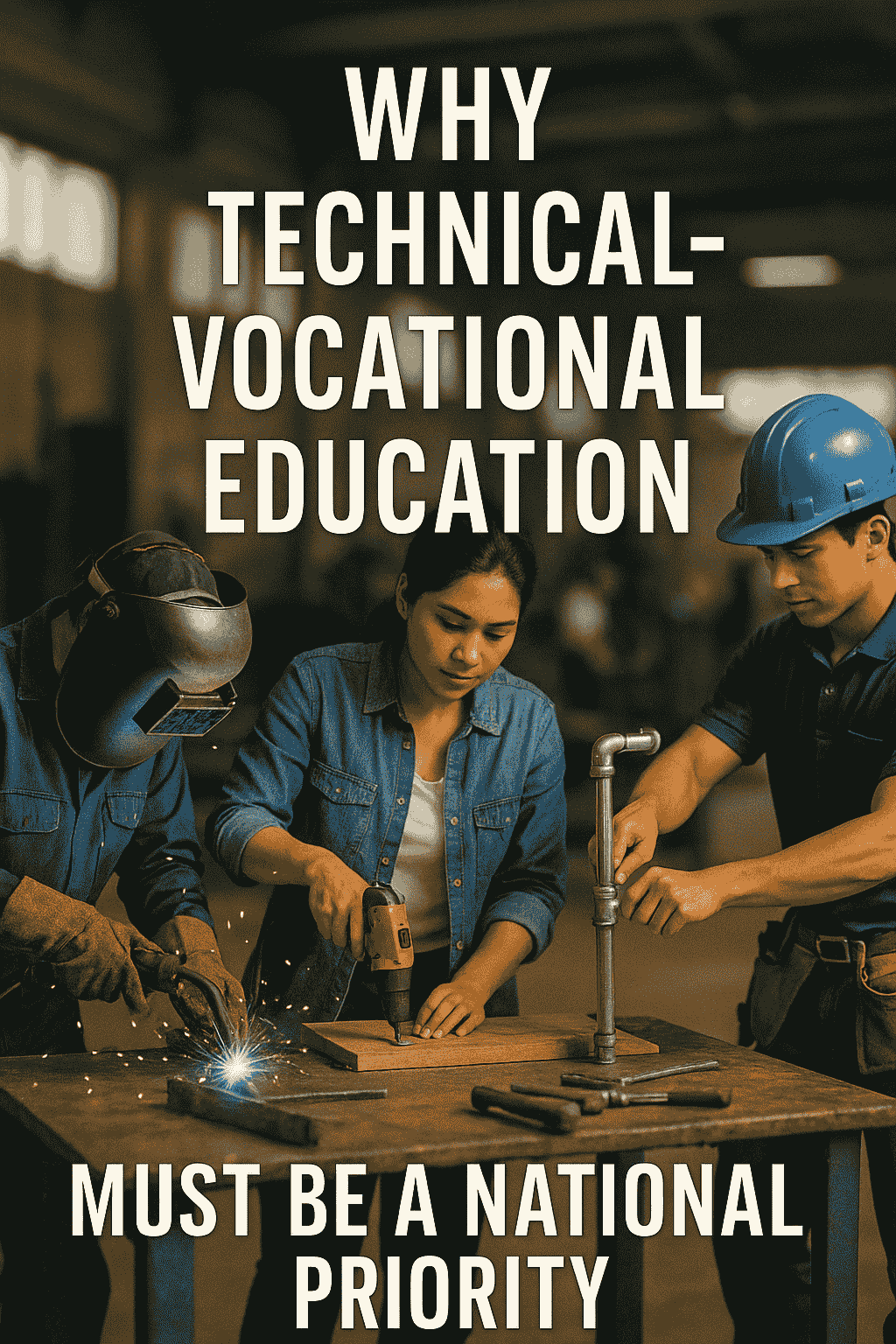
Why Technical-Vocational Education Must Be a National Priority
DOI:
https://doi.org/10.64591/fgrnwg05Keywords:
Technical-Vocational Education, Skilled Workforce, National DevelopmentAbstract
Technical-vocational education in the Philippines must be recognized as a national priority to address critical skill shortages in construction, manufacturing, agriculture, caregiving, hospitality, and IT. Properly funded and supported TVET programs transform students into employable professionals, drive economic growth, and build community resilience. Prioritizing TVET ensures a skilled workforce ready to meet the nation’s evolving labor market needs.
References
Edralin, Divina, & Pastrana, Ronald. (2023). Technical and vocational education and training in the Philippines: In retrospect and its future directions. Bedan Research Journal, 8, 138–172. https://doi.org/10.58870/berj.v8i1.50
Epetia, M. C. F., & Villena, I. C. F. (2023, May 9). Responding to the changing needs of the labor market: Overview of the country’s TVET. Philippine Institute for Development Studies Policy Notes (PN 2023-10). https://doi.org/10.62986/pn2023.10
Generalao, Ian Nicole, Balaoro, Jennylyn, Lorenzo, Pauline Joy, & Rivera, John. (2025). Examining the Effects of Technical Vocational Education and Training (TVET) on Employment Outcomes in the Philippines. https://doi.org/10.62986/dp2025.08
Mariano, R. P., & Tantoco, L. F. (2023). Assessment of Employability Skills of Technical-Vocational Education and Training (TVET) Graduates: Basis for an Enhancement Program. International Journal of Multidisciplinary: Applied Business and Education Research, 4(5), 1734–1747. https://doi.org/10.11594/ijmaber.04.05.34
Orbeta, A. Jr. C., & Corpus, J. P. P. (2024, March 11). Issues in Philippine TVET: Responsiveness to industry demand and barriers to access among disadvantaged youth (Research Paper Series No. RPS 2024-03). Philippine Institute for Development Studies. https://doi.org/10.62986/rps2024.03
Downloads
Published
Issue
Section
How to Cite