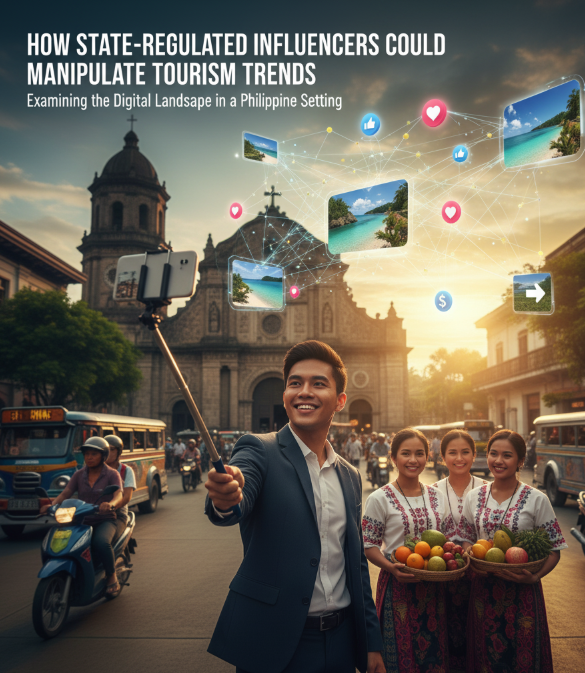
How State-Regulated Influencers Could Manipulate Tourism Trends
DOI:
https://doi.org/10.64591/7k0z7x31Keywords:
State-regulated influencers, tourism manipulation, authenticityAbstract
This paper examines the potential risks and consequences of state-regulated influencer campaigns in shaping tourism narratives. While influencers have become effective tools for promoting destinations, government co-optation risks turning tourism into propaganda by fabricating appeal, undermining authenticity, and misleading travelers. The study highlights the tension between beneficial collaborations and manipulative practices, emphasizing the need to safeguard authenticity in digital tourism promotion.
References
Atasoy, F. (2021). Authenticity in tourism. Academic Turkish World Studies: Tourism, Culture, Art and Architecture, 377–398.
Azizah, F., & Said, L. R. (2024). Influence of the role of government, travel barriers and social media influencers on visiting interests with destination image as a mediating variable: Study on Murung Batu Laba tourism visitors, Banjar Regency. Journal of Entrepreneurship & Business, 5(2), 175–187.
Bangahan, S., Daguplo, M. G. L., Hayudini, M. A. A., et al. (2025). Role of tourism branding communication in shaping destination perceptions and visitor behavior engagement. Environment and Social Psychology, 10(6), 3272. https://doi.org/10.59429/esp.v10i6.3272
Benhaida, S., Safaa, L., & Perkumiené, D. (2024, January). Influencers and tourism: Story of a recent and revolutionary phenomenon: What does bibliometric analysis reveal? In ENTER e-Tourism Conference (pp. 421–433). Cham: Springer Nature Switzerland.
Francalanci, C., & Hussain, A. (2014, December). A visual analysis of social influencers and influence in the tourism domain. In Information and Communication Technologies in Tourism 2015: Proceedings of the International Conference in Lugano, Switzerland, February 3–6, 2015 (pp. 19–32). Cham: Springer International Publishing.
González‐Díaz, C., & Quintas‐Froufe, N. (2024). Regulating influencers' commercial communication: No legislation, hardly any self‐regulation and policy recommendations. Policy & Internet, 16(4), 859–878.
Milenkovski, L. (2024). Empirical research of the influence of e-propaganda on the development of a tourist destination (Case study: North Macedonia). София, 104.
Reamico, D. M. D., Bangahan, S., Hayudini, M. A. A., et al. (2025). Strategizing marketing initiatives from tourism-seeking behaviors among travelers. Environment and Social Psychology, 10(7), 3880. https://doi.org/10.59429/esp.v10i7.3880
Downloads
Published
Issue
Section
License
Copyright (c) 2025 PINAS GAZETTE: Essays, Stories & Poetry

This work is licensed under a Creative Commons Attribution 4.0 International License.
How to Cite